
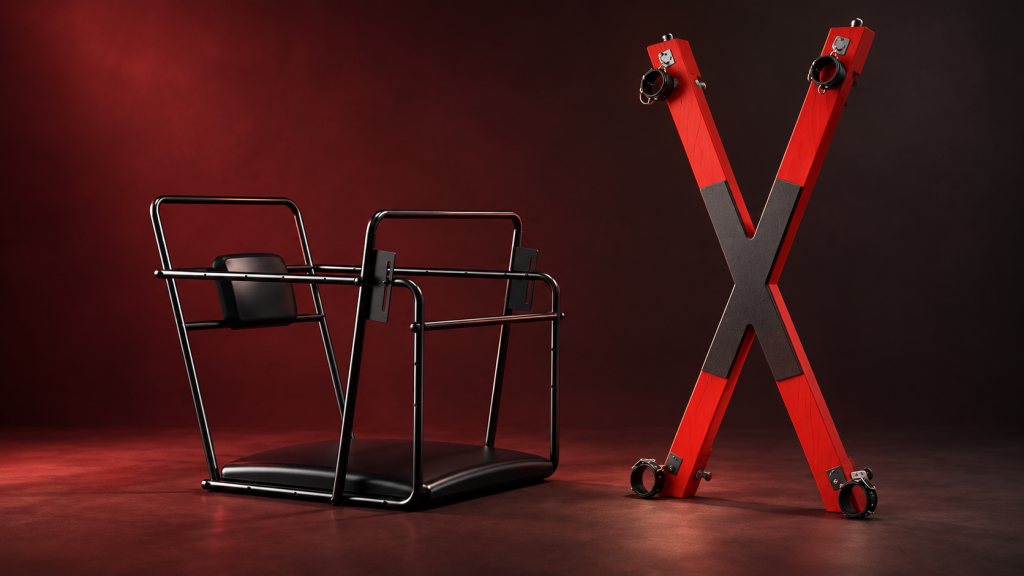
Choosing BDSM furniture is easier when you start with the room, the people using it, and the kind of support you actually need. A visually striking piece can still be the wrong purchase if it blocks a doorway, puts pressure on a joint, is difficult to clean, or cannot be stored. The best choice is a stable, comfortable piece that fits your intended activities and that you can inspect, maintain, and use within its stated limits.
Quick answer: Begin with a chair or compact bench if you want a defined seated or supported position. Consider a foldable board if storage matters more than permanent furniture. A cross, bed, or cage needs more deliberate room planning and closer attention to assembly and access. In every case, compare the exact model’s dimensions, materials, attachment points, weight guidance, and care instructions before ordering. Explore Roomfun’s BDSM Furniture range to see how these formats differ.
Start with the purpose, not the appearance
“BDSM furniture” and “bondage furniture” are broad shopping terms, not a single product type. A chair supports a seated position; a bench offers a raised padded surface; a board provides a flatter, more adaptable layout. Crosses, beds, and cages change the way people move around the equipment. Think about the posture, duration, accessibility, and level of adjustment you want. Then narrow the product category.
Ask who will use the piece, how they will enter and leave it, and whether a partner can reach every fastener without awkward stretching. A furniture item should accommodate the user’s body rather than forcing a pose because an attachment point happens to be available. If several people will use it, adjustable contact points and generous access may matter more than the number of restraints included.
A practical comparison of furniture types
| Type | Best starting reason to consider it | Planning priority |
|---|---|---|
| Bondage chair | Supported seated positioning | Seat fit, stable base, clearance on working sides |
| Bench | Raised padded support | Working height, padding, floor footprint |
| Foldable board | Flexible attachment layout and storage | Opened size, underlying support, hinge care |
| St. Andrew’s cross | Upright frame and distinct positioning | Height, anchoring instructions, access and release |
| Bondage bed | Large supported surface | Room size, frame strength, cleaning access |
| Cage | Enclosed furniture format | Entry, ventilation, door operation and rapid exit |
These are category-level differences, not promises about individual Roomfun products. The Bondage Furniture collection currently includes chair, board, bench, bed, cross, and cage designs. Check the individual listing for its actual specifications and intended setup.
Measure the working space before you shop
Write down the room’s usable length and width after accounting for existing furniture. Measure the route from the delivery point to the intended location, including door openings, stairs, and corners. A product may fit the room yet be impossible to carry through a narrow turn. For tall frames, compare product height with ceiling height and any light fixtures. For a bed or board, measure the fully assembled or opened size, not the shipping carton or folded size.
Next, add clearance for movement around the piece. You need space to approach the user, adjust hardware, step back, and release attachments promptly. A drawer or door that swings into the working area counts as an obstruction. Test a footprint by marking it on the floor with removable tape and walking the route you expect to take. If the route feels cramped without the product present, it will be worse after setup.
Permanent, movable, or foldable?
A dedicated room can accommodate a heavier chair, bed, or cross that stays assembled. In a shared room, storage volume and setup time can be decisive. A folding board may disappear into a closet, but it can occupy a generous floor area when opened. A compact chair may take less room during use while being harder to hide afterward. Compare both the working footprint and the stored footprint, then add the weight you will lift and the place where the item can dry after cleaning.
Match the furniture to the people using it
Comfort is not an optional luxury. Examine seat height, back support, padding thickness, edge shape, and the angle at which arms or legs will rest. On a bench or board, check where body weight is concentrated. On a chair, verify that the seat width and backrest suit the intended user. A position that looks manageable in a product image may feel different after several minutes.
Review adjustability with specific questions. Can straps be repositioned without taking the whole product apart? Can the user enter and exit without climbing over a hard edge? Can a partner reach a release point quickly? If the product will be shared, consider the range of body sizes it must accommodate. Do not assume every chair swivels, every board folds, or every cross can be mounted to a wall. Those details depend on the model.
Attachment points and restraints
Count attachment points only after checking their placement and construction. More rings do not automatically create more useful positions. A well-placed point should be accessible, free of burrs, and fixed to a part of the frame intended to carry the relevant load. Inspect the compatibility of cuffs, straps, and clips. Follow the product’s stated limits and never treat a ring on ordinary furniture as approval for suspension or overhead use.
Before any session, agree on boundaries and a stop signal. Keep a way to release every restraint readily available. Never leave a restrained person unattended. Recheck circulation, sensation, breathing, and comfort; stop immediately if there is numbness, tingling, unusual pain, dizziness, or breathing difficulty. These habits should influence what you buy: equipment that is hard to access or release is hard to use responsibly.
Inspect the materials beneath the finish
Product descriptions often highlight upholstery, but the structural frame matters just as much. Steel can provide a strong rigid frame when the joints and fasteners are well made. Wood can be sturdy when properly constructed and maintained. Neither material alone tells you the safe load or durability of a finished product. Look for model-specific guidance, solid joints, stable feet, smooth edges, and a frame that does not wobble during normal intended use.
Compare the surface material with your cleaning preferences. PU leather and PVC are generally easy to wipe, while genuine leather needs compatible care products and fabric may absorb moisture. Padding should give support without exposing hard pressure points. Stitching and seams should be even, and frequently handled straps should not show fraying. Where hardware meets upholstery, check whether the join is easy to inspect and dry.
Roomfun describes its collection using reinforced metal, wood, and padded surfaces, but construction differs across models. Read each listing’s materials and included components. A foldable board also calls for hinge inspection; a cross needs particular attention to its frame and installation method; a cage requires smooth door movement and a reliable exit route.
Plan for assembly, delivery, and maintenance
Find out whether the product arrives assembled, partially assembled, or flat packed. Check the dimensions and weight of the package, the tools required, and the number of people needed to move and assemble it. Follow the manufacturer’s instructions for every bolt, bracket, and anchor. Wall or ceiling installation should only be considered when the exact model permits it and the support and hardware are correctly rated. A photo showing a position is not an installation guide.
Maintenance starts before the first use. Inspect fasteners after assembly and at intervals recommended by the maker. Check feet or floor protectors for wear. On moving furniture, watch for looseness or unusual noise. On folding products, inspect hinges and handles. Replace damaged restraints and stop using the piece if a structural joint, attachment point, or locking mechanism becomes unreliable.
A simple cleaning routine
- Remove detachable accessories where the instructions allow it.
- Wipe contact surfaces with a soft cloth and a cleaner suitable for the exact finish.
- Clean seams and hardware without soaking padding, hinges, or frame joints.
- Dry the furniture and fittings completely before folding, covering, or storing them.
- Inspect for peeling, cracks, loose fasteners, rust, or fraying while you clean.
Avoid abrasive pads and unapproved solvents. Genuine leather may need a conditioner, while coated materials usually need a different routine. The manufacturer’s care label takes priority over a generic cleaning tip. Store furniture in a dry, ventilated place away from prolonged direct sunlight and avoid stacking heavy objects on padding.
Build a shortlist with a consistent checklist
Choose two or three product types and compare actual listings on the same criteria. Record assembled dimensions, shipping dimensions, weight, materials, stated load guidance, included accessories, assembly requirements, care instructions, and return or support information. Then give each item a practical trial on paper: where will it stand, who will move it, how will it be cleaned, and where will it go afterward?
For a first furniture purchase, start with the position you can use comfortably and the footprint you can accommodate. Resist buying a large frame for hypothetical future use if the room cannot support it now. A smaller item that you can set up and maintain properly may serve you better than an impressive piece you rarely use. Browse Roomfun’s BDSM Furniture collection, then open the exact product pages to verify every specification that affects your choice.
FAQ: Choosing BDSM furniture
What is the best BDSM furniture for a beginner?
There is no universal starter piece. A chair can simplify supported seated positioning, while a compact bench or foldable board may better suit another person’s room and storage needs. Prioritize stable construction, comfortable fit, easy release, clear instructions, and a manageable maintenance routine.
How much space should I leave around bondage furniture?
Leave enough clearance to enter, move around, adjust, and exit without obstruction. The exact amount depends on the product and room. Mark its assembled footprint on the floor, account for doors and drawers, and walk around it before purchasing.
Is a foldable board always the best option for a small home?
It may store compactly, but its opened working area can be larger than a compact chair’s. Compare both working and stored dimensions. Also consider where the board will dry after cleaning and whether you can lift and fold it comfortably.
Can I use any D-ring for suspension?
No. An attachment point does not imply approval for suspension, wall mounting, or overhead loads. Only use a product in ways explicitly supported by its manufacturer’s instructions and ratings.
Which upholstery is easiest to maintain?
Smooth coated surfaces such as PU leather or PVC are often straightforward to wipe, though seams and hardware still need attention. Leather and fabric have different care needs. Follow the instructions for the specific finish and let the item dry fully before storing it.
What should I check when a new piece arrives?
Confirm that the model and included parts match the listing. Inspect the frame, finish, fasteners, straps, and moving parts for damage. Assemble it according to the instructions, verify stability, and locate every release point before use.